

American citizen engineering and computer science graduates receive reduced entry-level job opportunities because of Optional Practical Training (OPT) in the San Francisco metro.

Earlier this month we published a report on the impact of STEM OPT workers on the Dallas-Fort Worth metro area. This week we published another short, easy-to-read report on STEM OPT workers, only this time for the San Francisco Metro Area.
And what better place to take a look at than the Bay Area/Silicon Valley, the great 20th-century geographic incubator that propelled the United States to dominance in the information age. For instance, in 1939, fresh out of Stanford, Bill Hewlett and Dave Packard started HP with $538 of seed capital. In 1957, eight engineers (aka, the Traitorous Eight) that included Robert Noyce and Gordon Moore (Moore’s Law) walked out of William Shockley’s semiconductor lab and founded Fairchild Semiconductor in Mountain View. In 1976, Steve Jobs and Steve Wozniak, working out of the Jobs family garage in Los Altos, built the Apple I computer. And in 1998, Larry Page and Sergey Brin, while Ph.D. students at Stanford, founded Google.
Given its history, one would think that top American talent would find a veritable Garden of Eden in the Bay Area. Sadly that’s not the case. The entrepreneurial, innovative, and inventive dynamism that was the heart and soul of Silicon Valley has been ripped out and substituted with corporate efficiency and a conveyor belt of cheaper, more compliant foreign workers. These days, the garage door isn’t open to the next Wozniak or Brin; it’s open to whichever visa or work authorization is cheapest to sponsor.
Our deep dive into OPT data in the San Francisco metro area between 2012 and 2022 tells a story that should trouble anyone who still believes programs like STEM OPT exist to fill unfillable gaps.
Jobs Grew Modestly. Guest Workers Exploded.
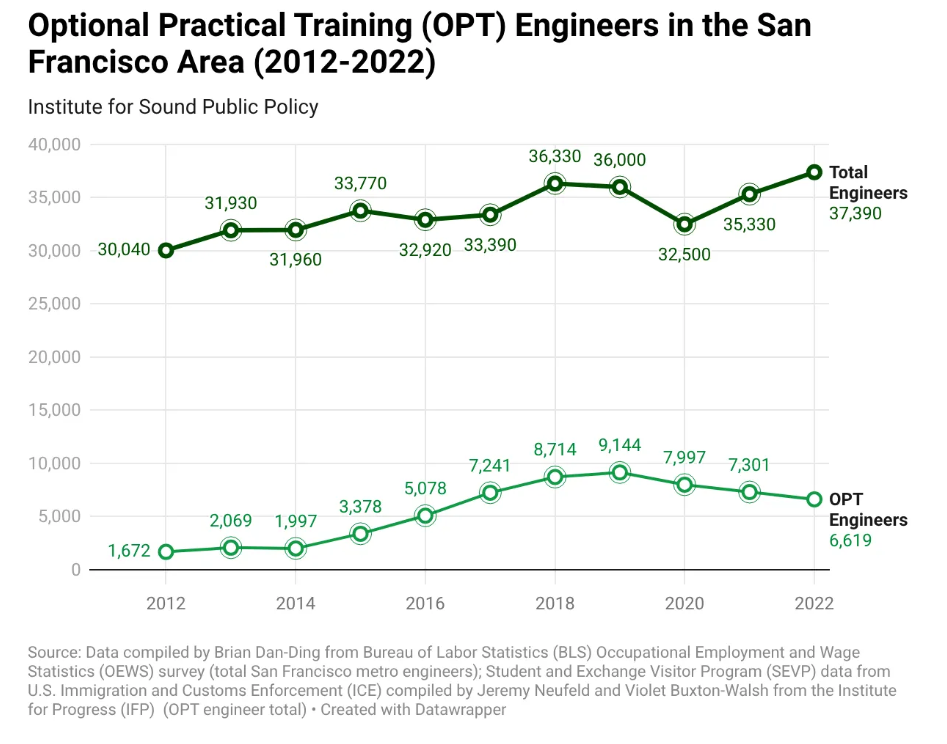
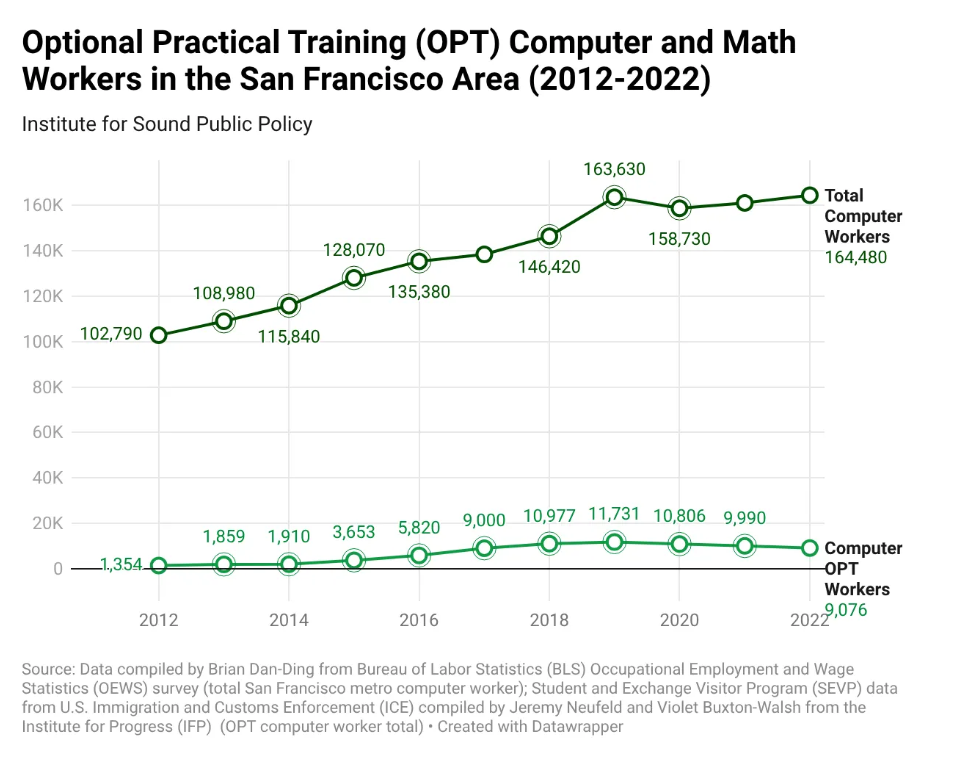
Between 2012 and 2022, engineering jobs in the San Francisco metro grew by roughly 25%. Computer and math jobs grew by about 60%, which is genuinely strong growth that reflects a decade of Bay Area tech expansion.
But look at what happened to the guest worker population riding alongside that growth. OPT engineers grew 300% over the same period, and OPT computer and math workers grew 570%.
Whatever is driving the number of foreign workers, it isn’t simply that the industry is booming. Let’s say a sector grows by 60% in a given period of time. You might expect the workers channelled into that sector to grow by 60% and not 1,000. That is not proportional growth, not by any stretch.
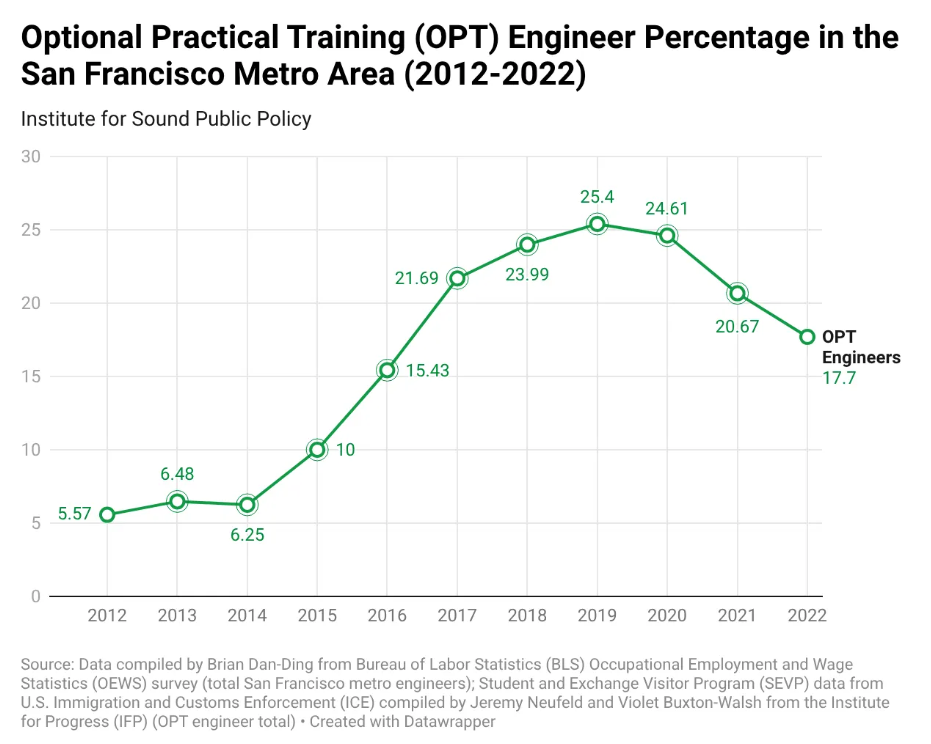
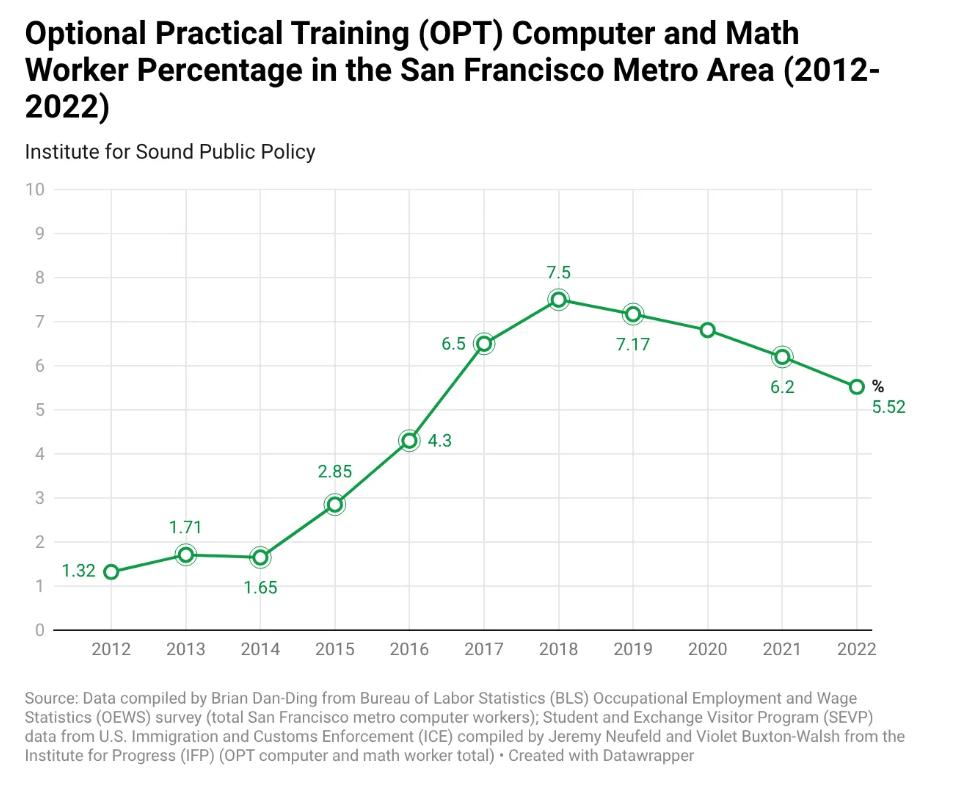
By 2022, OPT engineers made up 17.7% of the entire San Francisco metro engineering workforce, or nearly one in five engineers in the region. By 2022, OPT computer workers made up 5.5% of the entire San Francisco metro computer workforce.
Not PhDs. Not Scarce Specialists.
The usual defense of these numbers is that they represent talent that simply can’t be found here in the United States. As a result, employers are forced to look abroad for workers with rare talent and credentials. San Francisco’s data doesn’t support that defense.
Only 23% of OPT engineers in the metro pursued a U.S. PhD. That means 5,115 of the 6,619 OPT engineering jobs in 2022, or 77% of them, went to bachelor’s and master’s degree holders. Among computer and math workers, the picture is even more lopsided: just 7% held or were pursuing a PhD, meaning 8,407 OPT computer jobs, or 93% of the total, went to workers holding the exact same undergraduate and master’s credentials that tens of thousands of American computer science graduates hold every single year.
These aren’t hard-to-fill research positions. They’re the same entry-level and early-career roles that American new graduates are trying to break into. This is the first rung most people need to start up the career ladder. Moreover, over 90% of the OPT computer and math jobs identified in this report are entry or early-mid-level positions, meaning the real damage to American graduates in the entry-level job market is even larger than the raw percentages capture.
Why Employers Prefer the Guest Worker
This isn’t a mystery once you follow the incentives.
STEM OPT workers are exempt from Social Security and Medicare payroll taxes, and that is a 15% government-subsidized discount that employers get for hiring a foreign graduate instead of an American for the identical job. There is no wage floor tied to local market rates, no requirement that a company first attempt to recruit an American, and minimal oversight of whether the “training” component of these jobs is real or a formality on paper. In addition, there is no numerical cap for OPT, and universities devote as much time to recruiting foreign students as they do to matching them with an employer after they graduate. An administrator at the University of Maryland stated that the school has letters of agreement with over 200 companies.
Put a recent American graduate and an OPT-eligible international graduate side by side; with identical resumes, identical degrees, and the employer’s own payroll math, they can tell which one will be the most efficient hire. That’s not a talent decision. That’s a subsidy decision, and taxpayers are the ones footing it.
The National Trend Behind the Local Numbers
The Bay Area is at the epicenter of the American STEM joblessness crisis. It’s indicative of where the whole country is headed. A new Peterson Institute for International Economics analysis of government data puts the national scale of this shift in stark terms: the number of foreign STEM workers brought in and trained and educated at U.S. colleges and universities nearly tripled in twenty years, from 532,311 in 2003 to 1.464 million in 2023.
And here too, the PhD defense collapses under its own numbers. Of that 1.464 million, only 217,226, or about 15%, came up through a U.S. STEM PhD program. The other 85% hold bachelor’s or master’s credentials, the same tier of degree held by the American graduates competing for the same jobs.
The scale of the shift shows up in the growth numbers too as well. That same recent report found that foreign-born workers accounted for 36% of all US STEM job growth between 2000 and 2023. Not 36% of new PhD hires. Thirty-six percent of the growth across the entire STEM workforce. This has led to widespread displacement of American workers up and down the career ladder.
That is the injury. The insult is these foreign workers are not more talented; in fact, there is a body of evidence to suggest they are less talented than their American counterparts. And that is the insult.
Put the local and national data side by side, and the pattern is unmistakable. No one is going to argue against protecting a handful of irreplaceable foreign PhD researchers. The issue with Optional Practical Training is it has fueled a two-decade, nationwide substitution of the American STEM graduate’s first job.
What This Means for San Francisco’s Own Graduates
One might think the Bay Area would be the place where an American who earned a computer science or engineering degree from a California university, where a Hewlett, a Wozniak, and a Brin once did, would be able to gain a toehold in the industry that degree was built for. Instead, American graduates either graduating from or willing to relocate to the Bay Area for that first job are competing against a guest worker channel that grew many times faster than the jobs themselves.
Charlie Munger had a line that explains what our research is showing us. He said, “Show me the incentive, and I will show you the outcome.” The incentive here isn’t scarcity; it’s a 15% tax discount. The shortage story doesn’t hold up in Dallas. It doesn’t hold up in San Francisco either. What is being held up is a government labor subsidy to businesses that promotes not hiring American white-collar professional workers. It is an ever-increasing pipeline of foreign labor whose only purpose is to goose the supply of labor that will result in a generation of American graduates standing outside the garage door, wondering why it’s foreigners and they are not getting hired.
Visit us on Social Media:


USTW
IfSPP
