

When Principle Became Performance Part II of a series on the 114th International Labour Conference, Geneva

I became an admirer of Samuel Gompers, Founder of the American Federation of Labor (AFL) later in life when I found myself criticizing international trade deals such as the North American Free Trade Agreement (NAFTA) and unbridled immigration policies that struck me as both wrongheaded and counter intuitive to anyone that was pro labor. Even though I grew up in a union family, I didn’t fully appreciate role unions played in creating the country’s middle class. Truth be told, as a child, I probably saw the union as more of an annoyance recalling the two times my father’s union went on strike, one of which resulted in a Christmas were none of my siblings and I quite got what we wanted. And I would long for the day when the calendar that hung in the kitchen would once again show my father’s travel schedule.
My father was a Flight Engineer for Trans World Airlines and his union, the Flight Engineers International Association represented thousands of flight engineers. The flight engineer was a certified mechanic in the air who dealt with a range cockpit integration and mechanical duties.
Much like passengers at the time probably didn’t appreciate the skill and professionalism of the four men sitting in the cockpit of that four engine turbo prop Super G Constellation (“the Connie) that made long range luxury air travel possible from the mid-1950s through the early 1960s, I didn’t appreciate the role unions played in my family’s upper middle class lifestyle. Interestingly, my father was just the kind of skilled worker that Gompers would have built the AFL around when he founded it in the late 1880s.
Gompers was complex and at times contradictory as principle centered men can be. But he was no ideologue. He was deeper than any ideology and sought to manifest material real world gains for workers rather than utopian abstractions. He was also courageous and would not negotiate on principle while remaining brilliantly flexible on tactics. For instance, he was not a “socialist” and would not join a socialist party. He would attend their meetings but his focus was on organizing an economic movement of trade unionism.
In an era that produced many labor leaders, Gompers produced results that lasted because he understood that principle without strategy is sentiment, and strategy without principle is surrender. Those principles were formed in his early years through lived experience as a skilled worker.
He was born in London in 1850, the son of a cigar maker, and became one himself in the Lower East Side of Manhattan at thirteen. The cigar trade of that era was a community of skilled craftsmen who read aloud to each other while they worked. They would read newspapers, political philosophy and literature. Gompers absorbed Marx and Mill and the labor press in equal measure while at this shop he learned a craft that gave him economic leverage and formed the intellectual underpinnings of America’s most successful trade union. Thinking and doing created a unified field for Gompers as they do for any tradesman. That unity was not incidental to his vision. It was his vision.
In 1886 he founded the AFL on the premise that skilled workers, that is men whose particular knowledge could not be easily replaced and had the leverage to demand dignity from employers who needed what only they could provide. It was the philosophy of craft unionism. It was the knowledge of the skilled hand that became the foundation of worker power. Not ideology. Not revolution. Rather, the material fact of indispensability.
Then in 1914, he lobbied Woodrow Wilson’s administration with sufficient strategic cunning to inscribe the foundational principle of his entire life’s work into federal law. And there in Section 6 of the Clayton Antitrust Act appeared the declaration, The labor of a human being is not a commodity or article of commerce.
Gompers called it the Magna Carta of Labor. Five years later, at the Paris Peace Conference, he chaired the Commission on International Labour Legislation that wrote the same principle into the Treaty of Versailles and founded the International Labour Organization (ILO) to enforce it. Gompers accomplishments were significant and material and are still shaping the lives of workers like they did for my father decades after his death.
The Philosophy Gompers Lived
A century after Gompers founded the AFL, the philosopher and motorcycle mechanic Matthew Crawford published Shop Class as Soulcraft, a book that gave philosophical language to something Gompers had understood in his bones. Crawford’s argument is precise and radical. It is simply thinking and doing in skilled manual work is not merely economically valuable. It is the place where human beings most fully realize their higher self. The mechanic diagnosing an engine, the carpenter reading grain, the electrician tracing a fault through a string of cables are not simple labor inputs. They are expressions of irreducible human agency, judgment built through particular experience with particular materials, knowledge that cannot be abstracted, commodified, or replaced. An apprentice’s successful navigation of his trade over the years to mastery in aggregate is what advances the whole of a civilization.
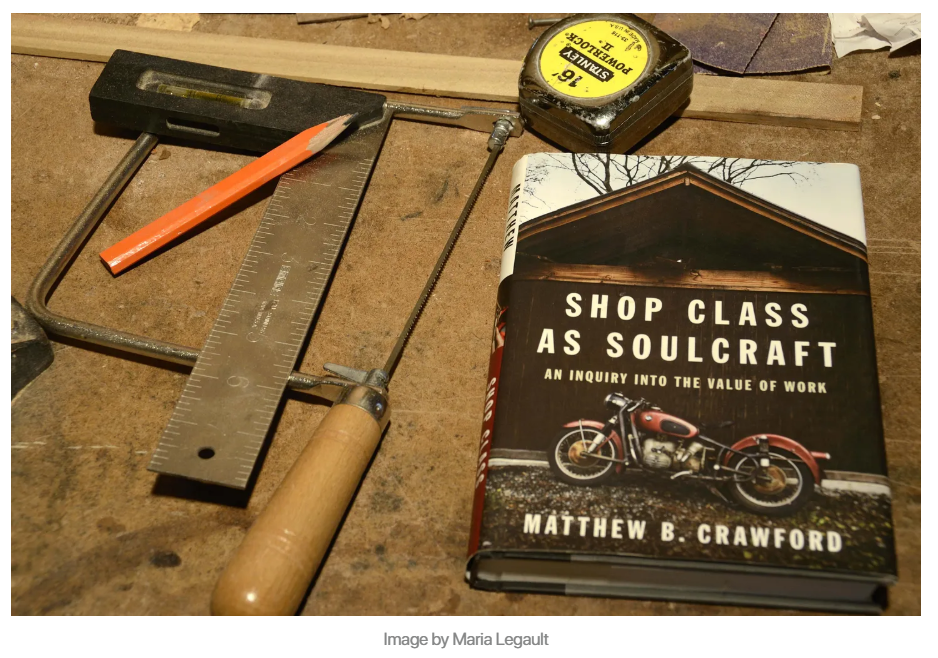
Crawford describes how American education and culture systematically devalued the generational knowledge over the course of the 20th century. Back in April I did a deep dive on how our managerial elite captured and degraded our institutions and how that managerial revolution separated thinking from doing. For instance, the manager class plans and the worker executes.
This perversion of work is what led to elevating symbolic manipulation over material engagement. People of my generation were steered toward college, toward the knowledge economy, toward credentials that promised participation in a world abstract than material. Concurrently, the trades were stigmatized and for reasons I have yet to understand, the union halls emptied. Shop class disappeared from high schools. The dignity embedded in skilled work was treated as a consolation prize for those who couldn’t get a college credential. “Oh, he’s a plumber,” snicker, snicker, snicker.
The destruction of that process has wreaked havoc on the foundations of our national economy. But that was not all.
What was also destroyed was a form of human flourishing that no knowledge economy credential can replace. Crawford calls it soulcraft, the making of a self through the making of things, the development of genuine competence through genuine resistancr with the world pushing back against the skilled hand and ultimately being shaped by it. That is what the word soul means in his title. It’s not a religious sentiment, but a kind of intrinsic human value. The irreducible worth of a person that precedes and supersedes any economic arrangement made about them. It is the seat of individual, institutional, national and civilizational virtue.
The Same Argument, A Century Apart
Both Gompers and Crawford understood the intrinsic value of work and how it resonated across society. “Labour is not a commodity” is a natural law statement. A commodity is interchangeable, substitutable, priceable by market mechanisms alone. To say labor is not a commodity is to say the human being performing skilled work cannot be reduced to an input. Because the market logic touted on financial news networks cannot capture that kind of value, our management elite cannot legitimately rule over it. That notion of a soul is what Gompers was defending when he refused to let the courts treat union activity as a restraint of trade. It is what the ILO’s Philadelphia Declaration was built to protect. That declaration was intended to be permanent. Sadly, it was not
What both these men understood about the true value of labor is now lost on the institutions that inherited the legacy of men like Gompers. There was an obligation to preserve the dignity of work and that is not political or ideological preference.
Hence, when that obligation is abandoned, when the institution begins to treat workers as a constituency to be managed rather than human beings to be defended, it has not merely failed. It has betrayed the principle it was founded to protect.
The Merger That Papered Over Everything
The AFL and CIO were not natural partners. The AFL was created as craft union of skilled workers who could leverage skills and talents hard to replace. Exclusionary as it was in practice, often shamefully so toward Black workers and immigrants, but it was philosophically coherent. Skilled workers had leverage.
The Congress of Industrial Organizations (CIO), founded in 1935, was industrial union whose members were vulnerable to industrialization at large scale. The CIO organized entire industries regardless of skill level. It was far more inclusive and significantly more radical than the AFL. Moreover, there was a substantial Communist Party influence over many affiliates. The differences in members and operating philosophies created tension between the two organizations.

The 1955 merger under George Meany papered over those tensions rather than resolving them. Meany was AFL through and through. He had a reputation for integrity, was conservative, anti-communist, comfortable with the foreign policy establishment and instinctively suspicious of the CIO’s radicalism. What emerged was an institution that inherited the CIO’s broader membership base and social justice vocabulary while operating with the AFL’s establishment-agreeable instincts.
The Long Surrender
The Cold War accelerated the drift. Through the American Institute for Free Labor Development, the AFL-CIO spent decades helping break left-led unions in Latin America in partnership with the State Department and the CIA. The federation that Gompers had built to defend American workers against institutional power became a junior partner to that power in its foreign operations. By the time North American Free Trade Agreement (NAFTA) arrived in 1993, the institutional transformation was complete. Although the AFL-CIO registered opposition to NAFTA, their resistance lacked the conviction and political independence to stop it as they were compromised by decades of accommodation to the very establishment interests that were pushing it through. Then to add insult to injury for workers, it was Bill Clinton, a Democrat who signed NAFTA into law.
The Economic Policy Institute estimated that NAFTA eliminated between 700,000 and 800,000 American job opportunities, with manufacturing bearing the brunt of the losses. Later with the passage of the World Trade Organization (WTO), it is believed the US lost roughly 3.7 million jobs to China between 2001 and 2008. Today, entrepreneurs are chastised for even thinking of manufacturing here rather than China.
The H-1B visa program is emblematic of the relentless push by globalists to crush workers they deem to be expensive, undeserving and expendable as well as the cozy relationship big business enjoys with our elected officials in Washington D.C. In an article of ours titled, The Rise and Fall of the H-1B Visa that was published last year in American Affairs Journal, we demonstrated the H-1B was created for the sole purpose of displacing American STEM workers. Yes, that is right, it is not being abused, it is working exactly the way it was intended.
From the 1960s through the mid-1990s these STEM workers built careers through genuine skill development and through the pursuit of particular knowledge. Their skills and work ethic enabled them to build the economic foundation for a dignified life. They were just the workers Crawford described in Shop Class As Soulcraft who are now being displaced by cheaper imported labor while the AFL-CIO maintains institutional silence.
Nothing illustrates unions losing their way more than what has happened over the past two years with commercial drivers licenses (CDL).
The CDL used to represent hard won particular knowledge and proficiency when it came to handling 80,000 pounds of steel at highway speed, navigating logistics nightmares, maintaining equipment, and carrying the legal and physical responsibility for cargo and public safety. It used to take years to earn. It is irreplaceable, indispensable and just the kind of skill-based credential Gompers built the AFL to protect. And the Teamsters, the union that exists specifically to represent the people who hold that credential has been silent while CDLs were being issued to workers of questionable immigration status, directly threatening the integrity of the credential and the livelihoods of the workers it represents.
It was not the Teamsters who brought this issue into public consciousness. It was American Truckers United (ATU). ATU is not a legacy institution, it’s not a union, a Geneva credentialed federation, it’s not an organization with per diems. It is an organization that rose up quickly that publicly identified the problem, absorbed the inevitable backlash, and did the material work of worker advocacy that the failed institutions refused to do.

Gompers would have immediately recognized ATU. The particular material problem in this case was the workers whose livelihoods were being directly threatened by bad immigration policy. ATU refused to be silent in the face of institutional pressure and blew the whistle on serious problem organizations like the Teamsters refused to even acknowledge.
Geneva: Where the Performance Lives
This is the second installment in a series that I began to write while attending this year’s International Labour Conference in Geneva. I found myself with more time on my hands than I would have cared for because despite being there as a credentialed member of the American workers’ delegation, the AFL-CIO had an issue with my being there. They filed a legal challenge to my being present. It amazed me to think the federation Gompers founded used the institutional machinery of his own creation to silence a voice advocating for the kind of workers he spent his life defending.
In the first installment I described the physical weight of the ILO building on the hill above Lac Léman with its brutalist concrete facades announcing institutional permanence while housing an institutional void. I stated:
“What Geneva built with his vocabulary was something else entirely. The ILO headquarters, the Palais des Nations, just down the road, are not emancipatory structures. They are administrative fortresses. They took the formal language of liberation and used it to house the opposite impulse. Not the freeing of human beings from industrial darkness but the management of human representation within acceptable procedural limits. In short, the béton brut aesthetic without the animating social vision.”
I have come to realize what fills that void is symbolic manipulation or what Crawford astutely identified as the elevation of language over material engagement, theater and performance over the addressing of actual problems.
Although Gompers’ principle was written into the Philadelphia Declaration and into the Treaty of Versailles by the man himself, and is read aloud at every ILO session, gender-responsive frameworks, intersectionality doctrine, and diversity resolutions are now shoe-horned into almost every plenary and breakout session. Sadly none of that will change the material condition of a single gig worker, a single displaced manufacturer, a single technology professional replaced by a cheaper imported substitute.
Social justice priorities that have nothing to do with the material needs of workers have placed the labor movement into conflict with its own soul.
What the Soul Requires
Gompers’ genius was translating the particular into the universal without losing the particular in the process. “Labour is not a commodity” is a universal statement that protects the specific human being. That is what institutions have lost.
What genuine labor advocacy looks like is what the ATU took it upon themselves to do and the Teamsters refused to, what U.S. Tech Workers has practiced over the past ten years and the AFL-CIO tried its hardest to suppress. This further informs me that captured institutions cannot offer a legitimate path forward for American workers in a time of great upheaval and chaos.
Labor Day honors the material contribution of working people. Their hands. Their knowledge. Their irreplaceable particular craft. A job is much more than money. Gompers and Crawford understood the soul of the work is the soul of the worker and from work comes a wellspring of virtue.
Today, the institutions built to protect that soul have become its most sophisticated suppressors. They speak the language of dignity while managing its disappearance. They have turned principle into performance so completely that many of their own members can no longer tell the difference.
The labor of a human being is not a commodity or article of commerce.
Gompers got those words into federal law in 1914. Into international law in 1919. With tactical cunning, strategic patience, and the courage that would not negotiate on principle.
This Labor Day, the institutions that bear his name are filing legal challenges against the people still trying to enforce it. The soul of the work remains. The institutions built to defend it have become little more than theater in its defense and nothing more. But dear reader, that is where you and I come in.
Visit us on Social Media:


USTW
IfSPP
