|
Dear {name}:
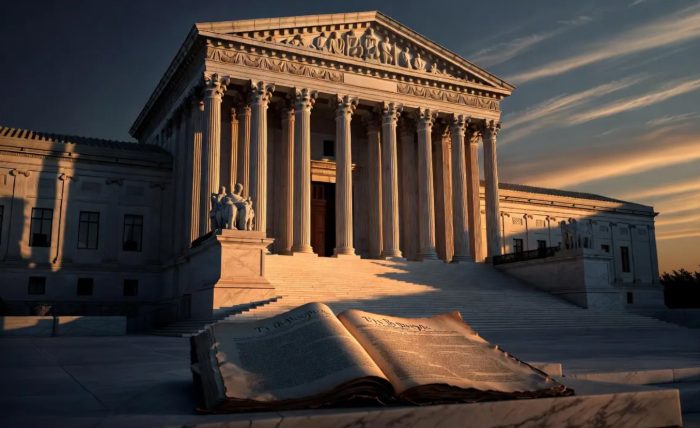
Yesterday the Supreme Court ruled 6-3 (5-1-3) in Trump v. Barbara, striking down the administration's executive order on birthright citizenship and affirming that children born in the U.S. to undocumented or temporarily present parents are citizens at birth under the Fourteenth Amendment. Those of us who have always believed the Fourteenth Amendment was the prerogative of American Descendants of Slaves (ADOS),and they alone, have in a sense been betrayed by this opinion. Lyman Trumbull, then chair of the Senate Judiciary Committee, stated on May 29, 1866:
“The provision is, that ‘all persons born in the [U.S], and subject to the jurisdiction thereof, are citizens. . . What do we mean by [it]? Not owing allegiance to anybody else. That is what it means.”
The intention of the Fourteenth Amendment was to ensure those freed from bondage following our bloody civil war would not be returned to servitude; that they were and would remain fully enfranchised citizens of this country.
The above sentiments are echoed in Justice Thomas’ dissenting opinion:
“Congress implemented the principle that citizenship follows birth and domicile in the Civil Rights Act of 1866 and then in the Citizenship Clause of the Fourteenth Amendment. The Civil Rights Act guaranteed citizenship to the persons who were both “born in the United States” and, as relevant here, “not subject to any foreign power.”
Oddly, the majority opinion rested on a flawed interpretation of citizenship going back over 125 years to the 1898 SCOTUS ruling in United States v. Wong Kim Ark.
Chief Justice Roberts, a Bush appointee who wrote the majority opinion, even cited English common law stating, “children “born within [sovereign’s] dominions” owed a “natural allegiance” to the sovereign who protected them at birth.” This would be laughable if it weren’t so serious. Really Justice Roberts, we fought the revolutionary war 250 years ago to free us from English common law!
Notably, Justice Barrett, a Trump appointee, joined the majority opinion in full. Justice Kavanaugh concurred in part and dissented in part, believing it did not violate the Constitution but did violate the Immigration and Nationality Act. Thomas, Alito, and Gorsuch dissented.
This is a significant loss, and I won't pretend otherwise. But understanding exactly what kind of loss it is matters for what we do next.
There won’t be a quick fix. Sure, the prestige of the Court has diminished greatly over the years, and it can be argued what needs to be done is change the composition of the court. But can this be counted on to right the ship?
The ruling was grounded directly in the Constitution itself, not just statute. That forecloses the easiest workaround, which would be Congress passing a law to override a constitutional holding. No statute, however clarifying its intent, can undo what the Court just said the Fourteenth Amendment requires.
But ways forward exist.
As Ryan Girdusky wrote in a post on X yesterday, “In the same way that the right started a legal movement to overturn Roe, we need a legal movement to overturn this terrible decision of birthright citizenship. The child of a Chinese spy born in the states is not an American.”
In the long run we must be strategic. The surest path that directly changes the rule is a constitutional amendment: two-thirds of the House and Senate, then ratification by 38 state legislatures.
This is an extraordinarily high bar and should be treated as a generational project, not a single election cycle. Winning more seats in Congress is necessary but is nowhere close to sufficient on its own, as the real bottleneck is the states. Thirteen holdout state legislatures can block ratification no matter what happens in Washington. Any serious long-term strategy has to build power in statehouses and not just on Capitol Hill.
In the short and mid-term, we must react with actionable policy changes. President Trump must exercise his authority using the Immigration and Nationality Act and proclaim that women of child-bearing years who aren’t legal immigrants are largely barred from the United States. As @8USC12 stated in an X post, no admittance and removal of those here on F-2 and J-2 visas and H-4 EADs (essentially spouses.) We can also deal a severe blow to the birth tourism industry by restricting women who are pregnant from entering the country.
Congressman Chip Roy introduced late last year the PAUSE Act that would freeze all immigration to the United States with few exceptions until certain conditions are met to ensure our immigration system is working on behalf of the American People.
We need to explore potential legal and legislative openings to answer questions the Court didn't address, such as emerging reproductive arrangements, jurisdictional questions in certain territories, and other statutory documentation standards distinct from the citizenship question itself. These options are narrower but represent opportunities where careful litigation can still do real work without inviting another defeat on the core question.
Pass the SAVE Act! Voter ID is something the vast majority of the American people want, President Trump wants, and the House of Representatives passed. Now it is time for the Senate to act. Eliminating election fraud is the first step in creating super majorities in the Congress and state legislatures.
In closing, we must be as stalwart as we are creative. We may appear to be hemmed in. But there is always a way forward. Remember the words of Sun Tzu in his Art of War:
“There are not more than five primary colors (blue, yellow, red, white, and black), yet in combination they produce more hues than can ever been seen.”
“There are not more than five cardinal tastes (sour, acrid, salt, sweet, bitter), yet combinations of them yield more flavors than can ever be tasted.”
Onward,

Kevin Lynn
Executive Director, Institute for Sound Public Policy
Founder, U.S. Tech Workers

|