|
Dear {name},
While delivering a presentation on the problems of legal immigration, I couldn’t help but think there are a number of ways outside of labor issues that immigration impacts Americans. An X post from a resident of Texas got me thinking concerns such as quality of life and social cohesion also need to be talked about.
Across the country, a heartbreaking transformation is underway—one that is reshaping the land, culture, and very soul of countless towns, leaving multi-generational Americans feeling homesick for a place they never left.
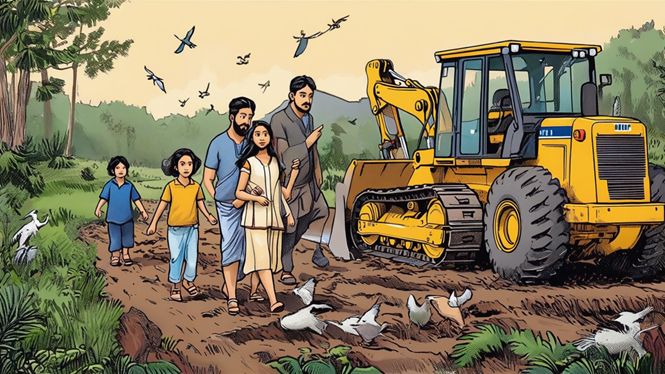
Nowhere is this cultural erosion more devastating than in the Dallas Fort Worth metropolitan area, where places like Frisco, Prosper, and Celina have been stripped of their rural character and transformed into anonymous suburban sprawl.
This is not the natural, organic growth that has defined American communities for generations. Rather, it is being driven by federal immigration policies that flood communities with foreign workers, particularly through the H-1B visa program. These workers often settle permanently and form insular communities, shattering the social networks and cherished traditions that once bound neighbors together.
The statistics are staggering. Frisco, once a tight-knit community of about 6,000 souls in 1990, has exploded to over 240,000 residents today. The farmland that fed families for generations is vanishing before our eyes. In nearby Gunter, a developer just closed on a 1,000-acre parcel—land that once sustained rural life—to build yet another massive housing development.
This tragedy isn't confined to Texas. In California's East Bay, the towns of Pleasanton and Livermore were once pastoral havens known for their vineyards, orchards, and horse trails. Today, much of that precious land has been bulldozed and replaced with dense suburban housing built specifically for H-1B visa workers. In Bentonville, Arkansas, and Raleigh, North Carolina, small towns with deep American roots are being transformed into globalized suburbs, often with no meaningful input from the families who have called these places home for generations.
As wave after wave of new populations arrive, the cultural landscape that took generations to build crumbles in mere years. In Frisco's public schools, 44 percent of students are now Asian, most of them South Asian. In some Prosper neighborhoods, Indian families make up over 90 percent of new homebuyers. The diners where families gathered for Sunday breakfast are replaced by Indian restaurants. Friday night football—once the beating heart of school life and community pride—is no longer the center of local culture. In its place are tutoring centers and weekend coding classes.
This isn't about denying anyone the chance to seek a better life. But Americans have every right to ask what kind of country they want to live in, and whether this relentless pace of change is fair to the families who built these communities. When farmland disappears forever, when historic towns lose their character and soul, and when local customs are quietly swept aside, it's not just a matter of growth—it's a matter of cultural survival.
Immigration policy may be crafted in Washington, DC, but the heartbreaking consequences are playing out in towns across America. Just because immigration is "legal" doesn't mean it serves the interests of the American people who must live with its consequences.
Americans need to demand honest answers to three fundamental questions: How many immigrants should we accept? How are those immigrants chosen? How do Americans benefit from immigration?
Local boosters often celebrate the growth, but few ask who truly benefits. Land developers and big corporations profit handsomely. But the average American family faces higher home prices, overcrowded schools, longer commutes, and a growing sense that they are becoming strangers in the places where they were born and raised.
What makes immigrant-driven growth different is the devastating lack of social cohesion that accompanies it. Strong, cohesive communities provide individual benefits that strengthen everyone, building the kind of social capital that makes neighborhoods into homes.
It's not too late to change course and save what remains of the America we love. But if we don't speak up now, if we don't fight for our communities and our heritage, the America we know will continue fading away—acre by acre, town by town, memory by memory.
Onward,

Kevin Lynn
Executive Director, Institute for Sound Public Policy
Founder, U.S. Tech Workers |