|
Dear {name},
The arrest of Mahmoud Khalil, a Palestinian activist and Columbia University graduate, by Immigration and Customs Enforcement (ICE) on March 8th, for his pro-Palestinian activism and alleged ties with Hamas, a designated terrorist group, has set off a debate for several reasons:
When ICE agents showed up at his New York residence to arrest him they were acting on a State Department order to revoke his student visa. When informed he held a Green Card as a lawful permanent resident, the arresting agents declared it revoked instead.
Because Khalil is a lawful permanent resident, a federal judge blocked any attempts to deport him and set up an expedited briefing schedule. He is scheduled to appear before an immigration judge on March 27th.
Although Khalil’s legal team is arguing his detention violates of his First Amendment rights, President Trump’s administration appears to have a work around that comes in the form of a rarely used clause found in the Immigration and Nationality Act (INA). Secretary of State Marco Rubio alleged his activism aligned with Hamas’s goals, tying it to INA Section 237(a)(4)(C)(i) for “adverse foreign policy consequences.” Invoking this clause gives the administration the right to remove Khalil expeditiously.
We can argue Khalil’s civil rights versus violations of the INA, but none of the above addresses the elephant in the room, which is - why Khalil and so many foreign students at universities, including Columbia are here in the first place? Why was ICE unaware of his change in status?
As of the 2023-2024 academic year, the U.S. hosted 1,126,690 international students at higher education institutions, this including students participating in Optional Practical Training (OPT) post-graduation.
In June of 2024, I wrote how the OPT program, is a one-year work permit for foreign students after they graduate that can be extended for another two years if the student majored in STEM. The program injects roughly 150,000 foreign workers into the labor market each year who compete directly with our US graduates for scarce jobs.
Last year attorney John Miano appealed Washington Alliance of Technology Workers v. DHS to the Supreme Court (SCOTUS) but the court chose not to hear it. The plaintiffs in the case called for the immediate end of OPT on the grounds it is an immigration program that was created through agency deference rather than legislated into existence by Congress. It was an important case because the OPT program is a significant inducement for foreigners to study in the US.
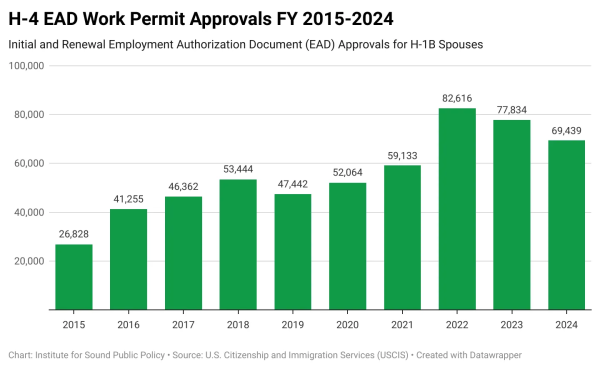
Save Jobs USA v. DHS may give us another bite at the apple should SCOTUS choose to hear it this year. Instead of OPT, the plaintiffs in this case argue that DHS exceeded its statutory authority by creating the H-4 EAD (Employment Authorization Document) program, as the Immigration and Nationality Act doesn't explicitly authorize work permits for H-4 visa holders. Moreover, some argue that significant immigration policy decisions (think OPT) should be made by Congress rather than executive agencies.
I believe if SCOTUS hears Save Jobs USA v. DHS, they will prevail - and if they do, it could end OPT as well. If there is anyway dear reader, for you to influence SCOTUS to hear this case, please do so!

Kevin Lynn
Executive Director, Institute for Sound Public Policy
Founder, U.S. Tech Workers |